



New research reveals a critical 'value delivery gap' as companies struggle to turn climate activity into measurable emissions reductions and business outcomes, yet the few with the right foundations in place report significantly stronger business benefits.
ZURICH — 21 October 2026 — Climate action is widespread across major companies, but most businesses are still struggling to translate climate goals into funded, implemented decarbonisation and measurable business value, according to South Pole’s 2026 Net Zero Report.
The study of 600 senior business decision-makers across Europe and the United States found that 90% report active climate initiatives, while only 43% have an approved climate strategy with implementation well underway. Just 23% say 75–100% of their climate-related business cases are approved by the CFO or investment committee in the past 24 months.
The report assessed respondents against core criteria to separate effective execution from ambition. The Advanced group (12% of the respondents) met all four criteria South Pole identified as the foundations to deliver value from climate action: a formal strategy under implementation, both value creation and risk protection outcomes built into climate plans or strategies, climate risk quantified or integrated into financial asset valuation or decision-making, and dedicated capital or operating budget for climate transition. The Aspiring group (the remaining 88%) did not meet all four.
South Pole calls this the value delivery gap, the disconnect between climate action and the ability to turn it into real results such as measurable emissions reductions and business value..
The findings point to an execution challenge. Climate activity often remains fragmented across sustainability, finance, procurement, operations and the supply chain, making it harder to prioritise interventions, secure funding, coordinate implementation and demonstrate results. Siloed responsibility was the most frequently cited barrier to capturing business value from climate action, identified by 24% of respondents, while 20% cited that sustainability and finance teams use different ways to measure value.
While 77% of respondents say they build both risk protection and value creation into their climate plans, 53% still describe their climate work as compliance-focused.
The research also found that companies in the Advanced group were nearly twice as likely than the rest of the sample to report stronger business outcomes:
Dara Olufon, Global Head of Advisory at South Pole, said: "Although companies have climate initiatives underway, they are struggling to deliver value, such as turning that activity into funded, delivered decarbonisation and business value across their operations and value chain. Companies that have our foundational building blocks in place are approximately twice as likely to report business benefits such as reduced costs, improved operating efficiency, and improved access to finance. However, this is only around 1 in 10 companies. It’s time for leaders to establish these building blocks and operationalise our four suggested actions in order to close this value delivery gap".
South Pole identifies four actions companies need to take to translate climate goals into measurable emissions reductions and business value:
1. Decide where to act
Identify and prioritise interventions across operations, and value chains based on emissions impact, business value, economics, implementation feasibility and risk.
2. Build the case and secure commitment
Translate priorities into executable and fundable plans by securing commitment through assigned executive ownership, dedicated budgets, and CFO sign-off to ensure full accountability.
3. Mobilise the right delivery model
Operationalise every intervention across core business functions rather than leaving delivery to sustainability alone; activating internal teams, suppliers, renewable energy, technology, capital, and market-based instruments to execute projects across the value chain.
4. Measure and prove results
Build emissions and business value measurement into delivery from the start, with the accounting, monitoring and reporting needed to demonstrate progress.
The findings underline a broader shift in corporate decarbonisation. Emissions sit across operations, and increasingly complex value chains, and the appropriate intervention differs by emissions source. Companies therefore need to connect strategy, implementation, market mechanisms and measurement around the same business problem rather than manage them as separate climate activities.
The full South Pole 2026 Net Zero Report and Benchmark Scorecard are available here.
Download the report to learn more about the four building blocks that turn climate action into business value, the barriers holding most organisations back and a practical roadmap to close your own value delivery gap.
South Pole is the world's leading carbon asset developer and climate consultancy.
Since 2006, South Pole has helped companies decide where and how to decarbonise, then mobilise what delivery requires across their organisation – including through suppliers, projects, technology and capital – to deliver measurable emission reductions and business value.. South Pole serves over 3,500 clients across the world, and its global team of experts has helped many Fortune 500 businesses translate net zero commitments into practical, investment-ready decarbonisation plans.
With more than 900 carbon projects in its global portfolio, South Pole develops project pipelines, structures carbon credit portfolios and mobilises financing and delivery partners, bringing together the capabilities and resources that companies cannot easily access or coordinate on their own. In line with its mission to deliver true climate impact for all, South Pole has helped reduce over 200 million metric tonnes of CO2 emissions to date, accelerated low-carbon transformations across several sectors, and provided measurable benefits to communities vulnerable to climate change.
The business is supported by world-class investors, including Temasek's GenZero, Lightrock, Corisol, and Salesforce Ventures.
South Pole is a social enterprise recognised by the World Economic Forum's Schwab Foundation.
For more information, visit www.southpole.com or LinkedIn.
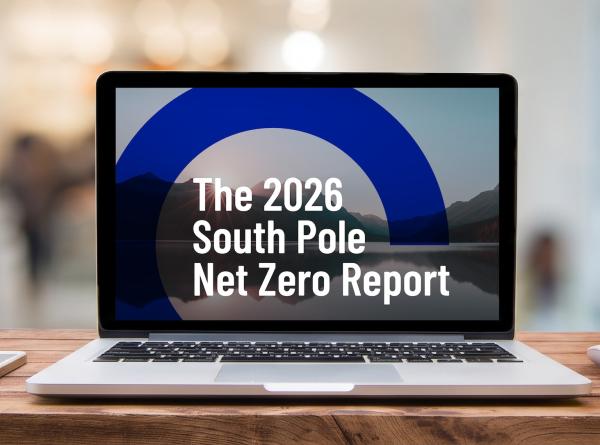
South Pole surveyed 600 senior leaders: 90% say their organisation has climate initiatives, but just 12% can consistently turn them into business value. Download the 2026 Net Zero Report.

Connect your climate ambition to financial reality. Discover how to close data gaps, model target scenarios, and execute credible transition plans.

Sustainability has moved from ambition setting to pragmatic action. Discover the differences and real-world examples of how climate leaders leverage climate action for value protection and value creation.