


Our ambition is to lead the way in carbon project risk management, quality and compliance protocols.
At South Pole, we are deeply committed to fostering trust and integrity across the carbon market. For us, integrity is not a theoretical concept, it is the fundamental principle guiding our actions at every stage of a carbon project, from project initiation through to implementation on the ground and quality control.
All our projects follow international carbon certification standards and their stringent quality requirements. On top of that we have incorporated a market-leading Quality Management Framework (QMF) that goes beyond the requirements set by the standards, and has achieved reasonable assurance from KPMG under the ISAE 3000 international standard. Our KPMG-assured QMF sets an advanced industry benchmark, providing a more stringent quality screen than standard registry compliance alone.
Our independent, in-house risk team defines our framework and oversees its effective implementation across all stages of our project work. Here's how we uphold this commitment:

At the core of our holistic approach to quality and integrity is our market-leading Quality Management Framework (QMF) governing project partner KYC and independent Quality Control of carbon projects. The framework has been refined across 350+ projects globally, and is built on a strong commitment to transparency—we disclose our findings so clients can make informed decisions.
Audited by KPMG under ISAE 3000, our QMF received reasonable assurance, the highest possible level, with zero exceptions noted. This independent audit confirms that the framework is fairly described, as well as suitably designed and implemented.
Our KPMG-assured QMF sets an advanced industry benchmark, providing a more stringent quality screen than standard registry compliance alone.

Our Quality Management Framework is managed by South Pole's in-house risk team and anchored by three pillars:

As a Carbon Asset Developer, since 2006 we have worked hand-in-hand with on-the-ground project stakeholders, supporting the delivery of tangible climate action. Our on-the-ground experience alongside project partners provides us with a deep understanding of the daily complexities, changing local conditions and social contexts and evolving technological possibilities. Our experts collaborate closely with project stakeholders to foster best practices and deploy innovations in project design and management, community engagement and data collection. This ensures that traditional knowledge is respected and integrated into carbon activities.

South Pole supports third-party ratings to enhance transparency around carbon credit quality and potential associated risks for buyers and stakeholders. Carbon project ratings provide buyers with important insights into the factors and context behind the projects that issue credits.
This is why South Pole engages third-party ratings agencies to perform independent reviews of selected projects. This further enhances risk management across our global project portfolio. The analyses and ratings of third-party carbon ratings agencies represent one important input to complement our internal assessments.
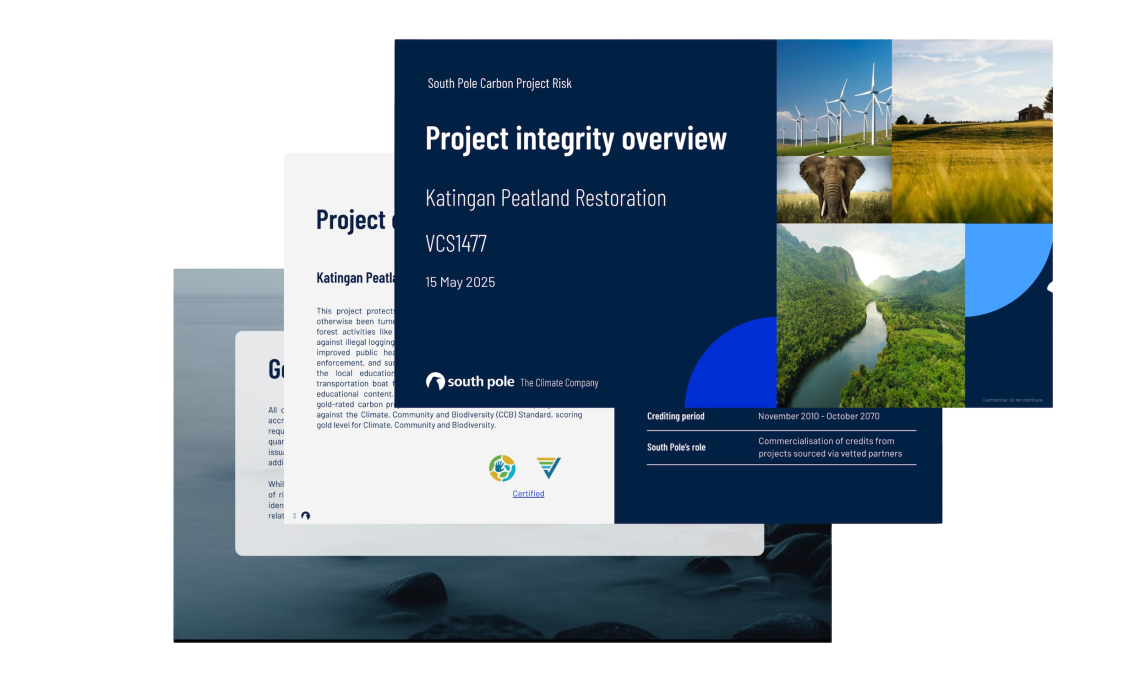
We are committed to helping our clients understand the complexities of carbon projects and the nuances that make up credit quality and integrity. We provide transparency to our clients and partners by:

South Pole leadership is made up of recognised leaders with decades of robust experience, who are helping the company navigate the next phase of transformation across global carbon markets, and drive innovation across our climate solutions.
Aligned with best practices of regulated industries, we have set up an in-house, independent risk function in charge of defining our quality management framework and overseeing its effective implementation. Our Chief Risk Officer sits on the Executive Committee and is accountable to the Board-level Audit & Risk Committee for effective risk oversight.


Learn how buyers can confidently engage with the evolving carbon market by downloading your copy now and adopting high-quality, integrity-driven practices.

Unlock carbon market confidence Learn what are high-integrity carbon credits, who sets quality and how South Pole helps. Read our blog series on this topic, starting here.

Navigate the 2026 carbon market structural shifts, avoid price shocks, and align with the latest SBTi standards. Download our guide to turn carbon credits into high-integrity strategic assets.






With over 20 years experience, we can help you navigate challenges and changes in the market.

Our projects are assessed against key quality criteria following a risk-based approach:
Project Partner KYC verifies the identity, integrity, and legal standing of the organisations and individuals we work with. It ensures that our business partners operate ethically and in compliance with our code of conduct.
We use industry-leading KYC software to screen business partners against sanctions, watchlists, politically exposed persons, adverse media and potential violations of United Nations Global Compact principles. Risk-based enhanced KYC involved deeper reviews of governance and legal standing, using additional documentation and local experts where necessary.
Additionality means the emissions cut or carbon removal only happened because someone paid for the carbon credits.
Our review covers prior consideration of carbon finance, regulatory barriers, financial barriers, technological barriers and common practice analysis.
Carbon accounting is working out how much carbon a project actually kept out of the air, or took out of it.
Overcrediting is when a project sells more credits than the carbon it genuinely delivered, so buyers pay for a tonne that was never there.
The two are linked: overcrediting is what happens when the accounting is wrong, or when the choices inside it are made generously rather than carefully. This can result from flaws in the methodologies used to estimate or measure emissions reductions, such as inaccurate baseline calculations or unreliable monitoring methodologies. To assess the risk of over-crediting, our review covers the robustness of the measuring, tracking and reporting processes in place, the conservativeness of the baseline and the risk of overlapping claims.
Permanence is the long-term storage of carbon dioxide or the permanent reduction of greenhouse gas emissions achieved by a project. Our approach is to assess permanence by considering internal and external factors. Internal factors mainly relate to the project proponent's capacity to implement and maintain the project activities in the long term, while external factors relate to natural disasters, unstable legal environments and socio-political stability in the project country. For nature-based projects where the stored carbon could be released back into the atmosphere due to various internal or external factors, a typical mitigating factor is a buffer pool of carbon credits to account for these potential reversals.
This means the project does not harm the people who live there or the nature around it: