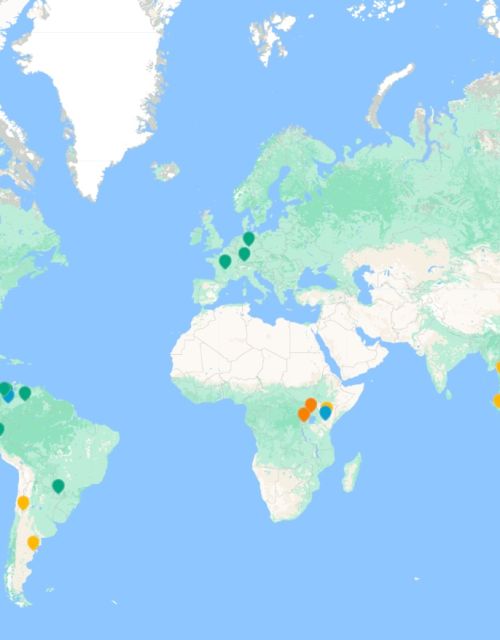
Global South jurisdictions are not just participants in the climate response; they are the frontline. While operating in these regions is often complicated, they also offer the greatest opportunities for large-scale lasting climate impact.
Regions such as Southeast Asia, Sub-Saharan Africa, and Latin America, face tangible challenges – from political uncertainty and economic volatility to critical infrastructure gaps. While these risks are well recognized, engaging with these markets remains non-negotiable to achieving global climate goals. The forests, ecosystems and natural assets critical to emissions reduction are overwhelmingly located in these regions. In fact, protecting and restoring key forest ecosystems alone account for roughly two-thirds of the total mitigation potential of all nature-based solutions worldwide.
That reality is why we prioritise work in complex markets. The potential impact is simply too significant to ignore.
A robust carbon market architecture is essential to translate this potential into performance. Standards bodies set rules and verification frameworks that define how credible carbon credits are generated and measured. They issue credits, verify them, exercise oversight over third party auditors (Validation and Verification Bodies), enforce the rules and act as depositaries of title. Carbon project developers implement mitigation activities on the ground, while carbon asset developers structure these efforts into scalable, investable portfolios working with buyers who finance the implementation activities that ultimately generate carbon reduction and avoidance impact. Working together under strong oversight, these actors ensure credits are high-integrity, verifiable, and trusted – helping to bridge the gap between ambitious climate finance and the operational realities of remote environments.
Operating in complex, emerging markets requires a sophisticated and proactive risk management framework to overcome unique challenges and deliver critical climate impact.
The long-term success of any climate mitigation project is inextricably linked to the stability of the host country’s governing landscape. Political interference can manifest as bureaucratic gridlock or the sudden introduction of new compliance hurdles that threaten to invalidate years of progress. Navigating this volatility requires constant, sophisticated on-the-ground intelligence to anticipate regulatory pivots, ensuring that the project remains both legally compliant and politically viable through successive administrations. Compounding these risks, institutional frameworks are often uneven — shifting with governments, with inconsistent oversight and resource management, and exposure to informal or non-regulated activities such as illegal mining and logging.
A forest carbon project in the Amazon can face challenges arising from overlapping government and policy regulations and unclear rules. Lengthy approval processes and evolving administrative requirements can delay project validation, force revisions, and push back credit issuance. Uncertain tax treatment can further reduce returns and complicate transactions, increasing overall costs and risk. As a result, even successful on-the-ground conservation efforts face financial and legal uncertainty due to political change.
The physical reality of operating in remote, under-developed regions creates logistical challenges that complicate every phase of project management. Without reliable road networks, the simple act of transporting personnel and equipment becomes a costly and time-consuming endeavor. This isolation is compounded by a lack of stable power and telecommunications, which directly hinders the ability to maintain the consistent data streams required for accurate emissions reporting. In such contexts, maintaining the technical integrity of the project requires significant effort to meet international verification standards.
While remote monitoring technologies have improved data collection, on-the-ground verification is still essential for project integrity. In parts of Sub-Saharan Africa, reaching project sites can require multi-day travel by boat and road, with limited or no mobile coverage, often relying on satellite phones and GPS equipment to maintain coordination and reporting.
Perhaps the most intricate challenge lies in the intersection of legal ownership and community dynamics. Demonstrating clear land tenure can take years, as developers must navigate overlapping claims and informal systems that may not be officially documented. Beyond the legalities, projects must integrate the principles of Free, Prior, and Informed Consent (FPIC), which means operating within the nuances of traditional governance and local customs. This requires a delicate balancing act - project developers must respect local heritage while simultaneously addressing ingrained social issues, such as gender inequality. Furthermore, community skepticism or resistance remains a constant reality. If local concerns are handled poorly, they can undermine the project's integrity. Navigating these complexities is not a one-time task but a continuous process of engagement that is vital for securing the long-term cooperation needed to protect project assets.
The interplay of institutional, technical, and social factors - alongside macroeconomic challenges such as inflation and currency volatility - makes financial management a high-stakes balancing act. By planning for uncertainty and integrating robust risk management, projects can balance costs while protecting the long-term value and permanence that define their success.
Our approach combines strong technical expertise with deep local insight, built through long-term partnerships with trusted regional actors. Their understanding of local history, governance, and social dynamics informs project design in ways that cannot be replicated remotely. Supported by robust governance and due diligence, this integration of local and technical knowledge allows projects to reduce implementation risk and improve long-term stability. These practices and our evolving operational approach are the result of years of on-the-ground experience, and adaptive learning.
More broadly, the carbon market is moving toward stronger social and environmental safeguards, reflected in updates such as Verra’s Version 5.0 Standard and in the emergence of new standards bodies such as Plan Vivo and Equitable Earth with a strong focus on social equity. At the same time, effective scaling depends on stability, certainty and predictability.
Projects should primarily be assessed against the standards under which they were originally validated, rather than shifting benchmarks mid-stream. The risk of retroactive criticism is that older projects collapse due to lack of funding, local communities are forced back into their old practices, and forests are destroyed, perversely causing the very carbon emissions that the new rules were designed to prevent. By balancing continuous improvement with consistency, the market can provide the certainty required for long-term climate investment.
To maximise climate impact in complex markets, organisations should focus on the following:
Don’t just consult; integrate relevant stakeholders into the governance structure. Establish robust, inclusive governance structures that formally integrate relevant stakeholders and recognise existing local leadership. These frameworks should be supported by rigorous due diligence, transparent decision-making, and clear dispute resolution and grievance mechanisms to ensure legitimacy, accountability, and long-term project stability. Equally, from a political risk perspective, it is important to embed projects within local legal frameworks that can endure shorter political cycles.
Maintain ongoing, two-way engagement with local communities and adjust approaches based on continuous feedback. Adaptive management models that draw on real-time data help refine operations, build trust over long timelines, and keep projects responsive to changing environmental, social, or political contexts.
Apply rigorous due diligence across all partners and projects, and prioritise collaboration with credible local organisations with "on-the-ground" tenure. Working with well‑established local partners strengthens delivery, improves risk management, and enhances long‑term project resilience.
In a maturing market, the carbon methodologies determined by established carbon standards like Verra, are regularly updated to introduce stricter accounting requirements. When this happens mid-cycle, it affects projected yields and financial visibility. While these changes improve accuracy, they should be recognised as an inherent market risk rather than a project failure.
Transitions require proactive engagement with local communities. If updated standards result in lower credit volumes without a corresponding price premium, the financial shortfall directly threatens the livelihoods of local stakeholders and the long term viability of the conservation effort.
Our mission is simply to drive real, measurable climate impact . Getting involved in complex markets is essential, because that is where the most profound and globally significant climate change mitigation happens. The journey may be complex and progress can be slow, but the long-term rewards are a transformative investment in our shared future.
We believe collaboration is key in making these initiatives a success. By working together through sharing resources, expertise and lessons learned, we can build stronger market infrastructure and scalable models that make meaningful climate action possible at pace and scale. Let's build the market infrastructure that makes global climate impact accessible, secure, and enduring.

Find out more about South Pole’s commitment to integrity, leading the way in carbon project risk management, quality and compliance protocols.